7 Content Tactics That Help Real Estate Businesses Dominate Google Maps
In the high-stakes world of real estate digital marketing, the landscape has shifted beneath our feet. As a consultant with over 27 years of experience in the trenches of Real Estate Investor SEO, I have seen algorithms come and go, but the current era is defined by one undeniable truth: real estate is won on the “block level,” not the city level. Today, 46% of all Google searches have local intent. This means that if you are a broker in Miami, ranking for “Miami Real Estate” is a vanity metric; winning the Map Pack for “Coconut Grove luxury condos” is where the commissions are actually made.
The “Map Pack” – those three coveted spots at the top of a local search – is the primary battleground for 2026. Buyers and sellers are increasingly skipping traditional organic results in favor of the Map Pack because it provides immediate trust signals: proximity, reviews, and visual proof of activity. If your business isn’t appearing in those top three spots, you are effectively invisible to nearly half of your potential market. To dominate, you must move beyond basic profile setup and embrace advanced content strategies that signal hyperlocal authority to Google’s sophisticated AI.
The Shift from General SEO to Hyperlocal Authority
For years, the mantra was “content is king.” In 2026, the mantra has evolved: “Hyperlocal relevance is the kingmaker.” Google’s local algorithm relies on three core pillars: Proximity, Relevance, and Prominence. While you cannot change your physical proximity to a searcher, you have total control over your Relevance and Prominence. Traditional SEO focuses on broad keywords, but google business profile seo now requires a surgical approach to content.
Consider the difference between a user searching for “Real Estate Agent Chicago” versus “Best Realtor near Lincoln Park Zoo.” The latter searcher is much further down the sales funnel and has high intent. Google recognizes this and will prioritize the profile that has established the most “Hyperlocal Authority” for that specific micro-neighborhood. If your profile only mentions the broad city, you will lose to the competitor who has optimized for the specific neighborhood nuances. This is a common reason why your real estate map pin is invisible to nearby homebuyers; you are competing for the ocean when you should be claiming the pond.
To win, your content must prove to Google that you don’t just work in a city – you “own” the block. This involves a shift from generic blog posts about “how to stage a home” to data-driven, location-specific content that mirrors the way local residents live and search. By focusing on these micro-signals, you build a “Relevance Shield” that makes it difficult for national aggregators like Zillow or Redfin to outrank you in the local Map Pack.
Tactic 1: Building “Block-Level” Neighborhood Guides
The most effective way to build relevance is through the creation of “Block-Level” Neighborhood Guides. These are not your standard community pages. To satisfy the 2026 algorithm, these guides must be hyper-specific, focusing on micro-locations such as specific school districts, boutique parks, or even the most popular local coffee shops. When you create content that mentions “The dog park on 4th and Main” or “The best espresso near the Heights Elementary,” you are feeding Google’s Natural Language Processing (NLP) the exact entities it associates with that geographic coordinate.
Google favors businesses that prove they “know the block.” This is because Google’s goal is to provide the most helpful result for the user. A realtor who provides a guide on the “Top 5 Quietest Streets in Shady Oaks” is demonstrably more helpful to a local searcher than a generic corporate site. This content should live on your website but be linked directly from your Google Business Profile (GBP) posts and “Services” descriptions.
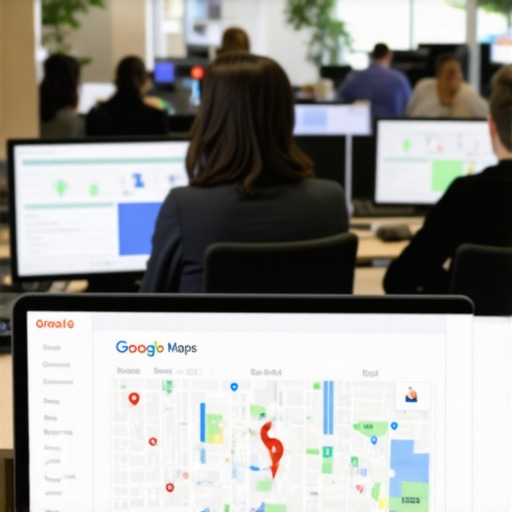
Actionable Tip: Don’t just write text. Suggest embedding a custom Google Map within these guides. On this map, pin your favorite local landmarks, recent sales, and upcoming open houses. When users interact with this embedded map on your site, it sends a powerful signal back to Google that your digital presence is intrinsically linked to that physical location. This is a foundational step in any robust google maps seo strategy.
Tactic 2: Keyword-Optimized Review Sourcing
In 2026, it is no longer enough to simply have a high volume of five-star reviews. The algorithm has evolved to analyze the sentiment and substance of those reviews. Google is looking for specific keywords within the user-generated content of your reviews to confirm your business category and service area. If a review says, “Great service,” it helps your reputation but does little for your Map Pack ranking. If a review says, “The best listing agent in West Village who helped us sell our house fast,” it acts as a massive ranking signal.
You must actively guide your clients to use these keywords without being overbearing. When you close a deal, send a follow-up that asks specific questions: “How did you feel about our service as your listing agent in [Neighborhood]?” or “Were you happy with how we helped you sell your house fast?” Most clients will mirror your language in their review. This is how you rank higher on google maps – by turning your clients into your most effective SEO copywriters.
Furthermore, your responses to these reviews matter just as much. When you reply, don’t just say “Thank you.” Instead, write: “It was a pleasure serving as your real estate agent in [Neighborhood]. We are so glad we could get your home sold over the asking price!” This reinforces the keyword association for Google’s crawlers. For more on this, check out our guide on how to source Google reviews that actually mention your keywords.
Tactic 3: Visual Engagement & The “Photo Depth” Signal
One of the most overlooked ranking factors in the modern local algorithm is “Customer Photo Scrolling Depth.” Google tracks how long a user spends looking at your photos and how many they scroll through. If a user clicks on your Map Pin and spends 45 seconds looking at 15 high-res property photos, Google interprets this as a high-quality result and will boost your visibility. Profiles with over 100 photos receive significantly more clicks and direction requests than those with fewer images.
Content isn’t just text; it’s visual data. For real estate, this means uploading high-resolution property photos, 360-degree virtual tours, and even “behind the scenes” photos of your team at local community events. You want to create a “visual rabbit hole” that keeps users engaged with your profile. The longer the “dwell time” on your photos, the higher your prominence score becomes.
Pro Tip: Ensure your photos are geotagged (though Google often strips EXIF data, the metadata still plays a role in internal processing) and that the filenames are optimized (e.g., “luxury-home-for-sale-austin-tx.jpg” instead of “IMG_1234.jpg”). If you are seeing a plateau in your rankings, it might be time to address 5 photo interaction fixes to boost 2026 local CTR SEO.
Tactic 4: Hyperlocal Video Content (Shorts & Tours)
Video is the ultimate engagement tool for 2026. With the integration of “Google Shorts” and video previews within the Map Pack, real estate professionals must leverage video content to stay competitive. Uploading “Property Tours” and “Neighborhood Walkthroughs” directly to your Google Business Profile keeps users on your profile longer, which is a key metric for ranking. Using local seo tools to track how these videos impact your click-through rate is essential.
A 30-second clip of a “Walking Tour of the Pearl District” or a “Quick Peek at a New Listing in Brentwood” provides immediate value. These videos should be raw and authentic, not just polished commercials. Google’s algorithm is increasingly adept at recognizing the content of videos; when it sees you physically standing in front of a local landmark or a house you just listed, it confirms your physical presence in that area. This “proof of presence” is a massive signal for local map pack seo.
Moreover, video content is shared more frequently than static images or text. Every time a user shares your GBP video or saves it to their “Want to go” list, it sends a positive interaction signal to Google, indicating that your business is a prominent local entity.
Tactic 5: Advanced Schema Markup for Real Estate Listings
While most of this guide focuses on the “front-end” of your content, the “back-end” technical content is what bridges the gap between your website and your Google Map Pin. Advanced Schema Markup is the language you use to tell Google exactly what your content is about. For real estate, you should be using RealEstateListing and LocalBusiness schema on every property page.
This technical content helps Google connect the dots. If you have a listing on your site for “123 Maple St,” and your schema markup includes the geo-coordinates, price, and neighborhood, Google can more easily associate that listing with your GBP. This creates a “Search Entity” that is much stronger than a simple website link. Many agents overlook this, making it the schema markup your competitors are ignoring that wins the Map Pack.
By implementing amenityFeature schema (e.g., “pool,” “near transit,” “hardwood floors”), you allow your listings to show up in “discovery” searches on Google Maps where users filter by specific features. This is a high-level google business profile seo tactic that separates the pros from the amateurs.
Tactic 6: The “Freshness” Factor: GBP Posting Strategy
Google has essentially turned the Google Business Profile into a social feed. Businesses that post regularly – at least 2-3 times per week – see a significant lift in their Map Pack rankings. This is known as the “Freshness Factor.” For a real estate professional, your posting strategy should revolve around “Just Listed,” “Just Sold,” and “Market Update” posts. This signals to the algorithm that your business is active and providing real-time value to the community.
Each post should include a high-quality image, a brief description using local keywords, and a clear Call to Action (CTA) like “Learn More” or “Call Now.” When you consistently update your profile, you are essentially telling Google, “We are the most active and relevant business in this area right now.” This is a core component of any professional google maps ranking service.
Don’t forget to use the “Offer” post type for things like “Free Home Valuation” or “First-Time Buyer Seminar.” These posts often get highlighted in search results, increasing your profile’s real estate on the screen and driving higher engagement. Consistency here is more important than perfection; a steady stream of updates is better than one perfect post a month.
Tactic 7: Leveraging CTR & Interaction Signals
The final frontier of Google Maps dominance is the optimization of Click-Through Rate (CTR) and user interaction signals. Google isn’t just looking at what you put on your profile; it’s looking at how users react to it. Two of the most powerful signals in 2026 are the “Save for Later” and “Share Location” gestures. When a user finds your listing and saves it to a list or shares it with a spouse via text, Google interprets this as a massive vote of confidence.
You can encourage these interactions by creating “Save-Worthy” content. For example, a GBP post titled “The 5 Best Hidden Parks in [City] – Save This for Your Next Weekend Out!” directly prompts the user to interact with the save feature. These signals tell Google that your profile is not just a listing, but a valuable resource. This is why the ‘Save for Later’ click is quietly boosting your local map ranking.
Additionally, focus on “Direction Requests.” Even if the user doesn’t end up driving to your office, the act of clicking “Directions” to a property you’ve listed or your office location is a high-intent signal that Google uses to gauge your prominence in the local market. Using google business profile optimization techniques to make these buttons more prominent is a winning move.
Conclusion: Measuring Success Beyond Rankings
Dominating Google Maps in 2026 requires a holistic approach that blends hyperlocal content, technical schema, and deep user engagement. While it’s easy to get caught up in where your pin sits on the map, the ultimate KPIs for any real estate professional are “Calls,” “Direction Requests,” and “Website Visits.” These are the metrics that lead to listings and closings.
By implementing these seven tactics – from block-level guides to keyword-optimized reviews – you are building a digital fortress that is resistant to algorithm shifts. You are no longer just an agent in a city; you are the undisputed authority of your local market. If you want to stay ahead of the curve, it is time to audit your profile or use professional Mastering CTR SEO: How to Elevate Your Local Search Presence Rapidly tools to track your performance and ensure you are winning the “block-level” battle every single day.