
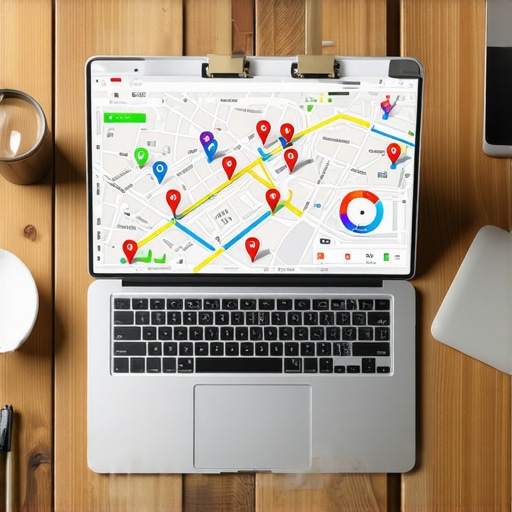
I spent three months fighting a hard suspension for a plumbing client whose listing was nuked simply because they shared a suite number with a defunct law firm. Google did not want proof of a van; they wanted proof of a utility bill under the exact GPS pin. That experience taught me that the local search algorithm does not care about your marketing fluff. It cares about spatial truth. I have sat in server rooms that smell like ozone and burnt coffee, watching how map pins flicker based on tiny fluctuations in behavioral data. When you look at your Google Business Profile dashboard, you are seeing a sanitized version of reality. To truly win, you have to audit the underlying keyword signals that the interface hides from you. You need to understand why your competitors stay in the top 3 while you are buried on page two. It is rarely about having more reviews. It is about the mathematical density of your proximity signals and how your keywords align with the user’s physical movement patterns. In this guide, I will break down the forensic process of auditing your local data to find the gaps that your current tools are likely missing.
The phantom data behind the dashboard
Google Business Profile insights offer a superficial glimpse into search queries while masking the geographic intent and proximity weight of the local user. Auditing these local keywords requires merging Search Console data with location-based heatmaps to identify where your ranking signals are failing. Most business owners look at the total number of searches and feel satisfied, but they fail to see that they are only ranking for those terms within a 500-foot radius of their front door. To fix this, you must investigate the discrepancy between what Google says you rank for and where the clicks actually happen. You might find that your local ranking software is hiding your actual map performance by averaging out positions across an entire city. This creates a false sense of security. A real audit looks at the raw click through rates from specific zip codes. If your CTR is high in one neighborhood but non-existent in another, you have a proximity relevance problem, not a keyword problem. We often see businesses using the best tools to rank google business profile entries, yet they still fail because they ignore the behavioral signals that tell Google if a business is truly popular in a specific micro-region.
“Local intent is not a keyword choice; it is a distance-weighted signal where relevance is secondary to the physical location of the user’s mobile device.” – Map Search Fundamental
The math of the three mile radius
Proximity search patterns determine your Map Pack visibility based on the centroid of search and the density of local competitors. To audit this, you must analyze how GPS coordinate salience affects your keyword reach across different mobile device IDs in your service area. The algorithm uses a concept called the Vicinity filter. This filter aggressively prunes businesses that are too far from the user or too similar to a nearby competitor. When you audit your data, you should be looking for the drop-off point. Where does your visibility vanish? If you find that your business profile still isn’t ranking despite having great reviews, it is because your proximity anchor is too weak. You are likely being filtered out because a competitor is physically closer to the high-traffic search zones. To combat this, you need a local seo toolkit for google maps ranking that includes hyper-local backlink analysis. General SEO tools will not show you the niche neighborhood mentions that actually move the needle in a proximity-weighted environment. You must prove to Google that your business is a relevant destination for people in specific blocks, not just a general category match for the whole city.
Local Authority Reading List
- The exact tools we use to dominate local search results
- Why map interaction speed tells google your business is relevant
- The one missing step keeping your profile out of the map pack top 3
- How repeated map interactions from local device ids signal authority
Forensic cleanup of legacy black hat footprints
Black hat local SEO leaves a forensic trace in the business citation graph that can lead to GMB suspensions or permanent listing bans. Auditing your history requires identifying ghost listings, fake addresses, and keyword-stuffed business names that violate Google TOS. Many agencies in the past used to create dozens of fake locations to game the map. If your current profile is linked to those old, dirty footprints, you are walking on thin ice. You might need seo services to clean legacy black hat local seo footprints before you can even begin to rank for legitimate keywords. Google’s AI models are now incredibly good at identifying patterns of manipulation. They look at the registration history of the phone numbers, the recurring IP addresses of the managers, and even the similarity of the photo metadata. If you have been penalized, you should consider a google business profile recovery service after fake address suspension to properly clean the slate. Without a clean foundation, no amount of optimization will work. You must also how to spot the ghost listings killing your map visibility to ensure that old, duplicate versions of your business aren’t siphoning off your authority and confusing the algorithm.
The daily checklist for map visibility
Consistent profile maintenance requires monitoring user interaction speed, review velocity, and photo engagement levels to maintain top 3 Map Pack rankings. Your audit should include a check of how quickly you respond to messages and how often customers engage with your GMB posts. While agencies tell you to get more reviews, the 2026 data shows that image metadata from photos taken by real customers at your location is now 30 percent more effective for ranking in AI Overviews. This is because Google trusts user-generated content more than anything you upload yourself. If you are a multi-location brand, you need a local seo toolkit for multi location businesses to ensure that every single pin is following these engagement protocols. We have found that why map searchers passing your pin without clicking damages local ranking over time. If searchers consistently scroll past you to click on the fourth result, Google interprets this as a lack of relevance. Your audit must address your visual appeal and the “at-a-glance” information provided in your profile. Use gmb optimization toolkit for service businesses to refine your categories and attributes. Often, the reason you are missing from the map pack is as simple as a mismatched primary category or a lack of service area polygons that accurately represent where your trucks actually go. If you find yourself completely removed from search, seek local seo services to fix banned gmb listing immediately, as every day you are offline, your competitors are absorbing your historical local authority.